
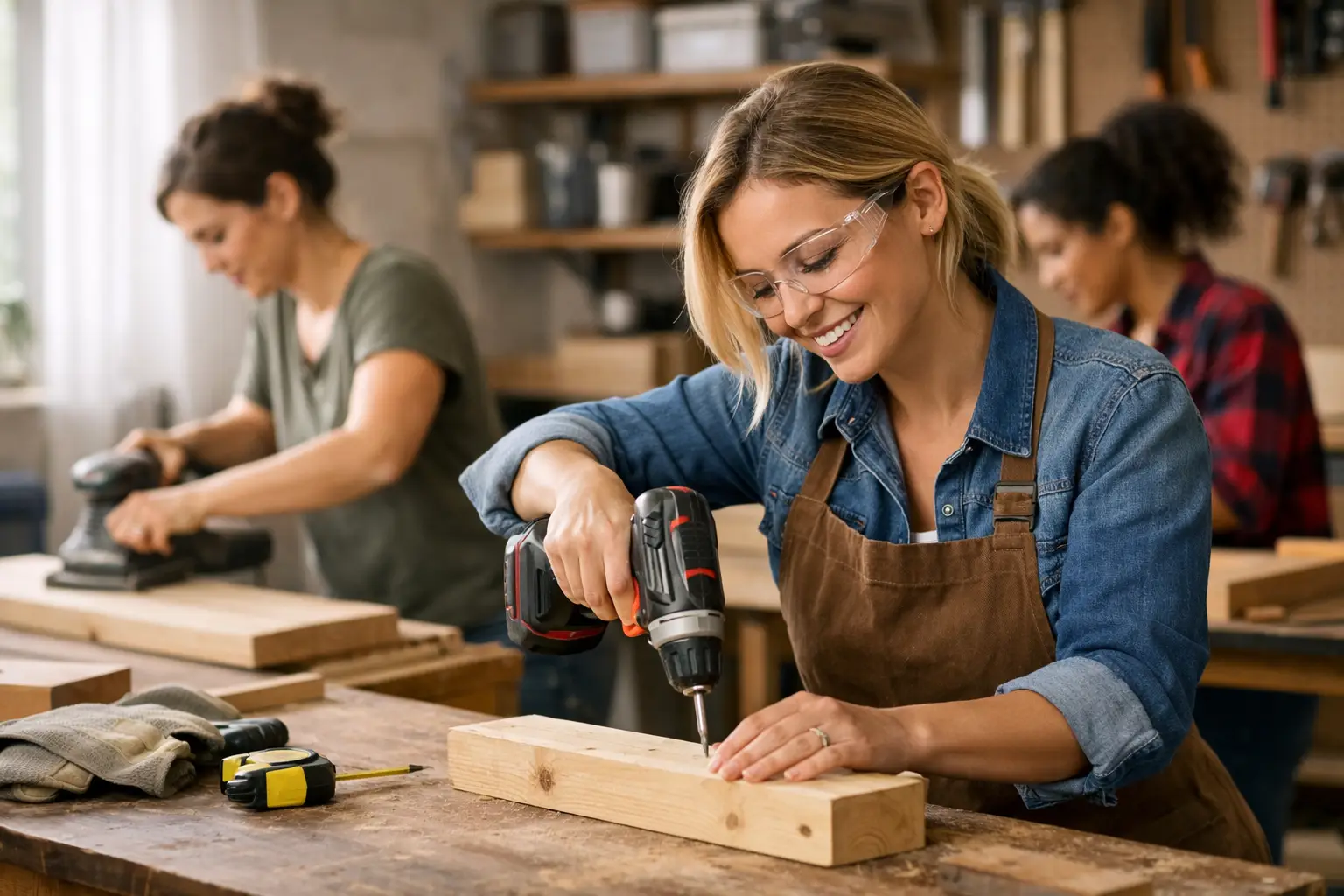

The first time you pick up a drill can feel far bigger than it should. It is not really about the drill. It is about all the messages that said tools were for someone else, that practical jobs were too technical, too messy, or too risky to learn later in life. A DIY workshop for beginners changes that quickly. Once you use the tools yourself, measure your own piece, make your own cut, and fix your own mistake, something shifts.
That shift matters because DIY is not just a hobby. It is a life skill. Knowing how to put up a shelf, use a wall plug properly, tile a small area, change a car wheel, or build a simple piece for your home gives you more than a finished project. It gives you confidence in your own judgement. It makes your home feel more manageable and less dependent on waiting for someone else to sort every small job.
What a DIY workshop for beginners should actually feel like
A good beginners workshop should not feel like being thrown into a trade test. It should feel welcoming, clear, and hands-on from the start. You do not need to arrive knowing the difference between every bit, blade, screw or fixing. That is the point of coming.
The best sessions break practical skills into simple stages and explain why each step matters. You might begin with the basics of measuring, marking out and using hand tools safely before moving on to power tools. Or you might work on a small project that teaches several skills at once, such as drilling, sanding, fastening and finishing. Either way, the learning should be active. Watching can help, but doing is what builds confidence.
Just as important is the atmosphere. For many women, the biggest barrier is not ability. It is intimidation. If the room feels too technical, too fast, or too full of assumptions, people stop asking questions. A supportive learning space changes everything. You can ask the obvious question, practise at your own pace, and make mistakes without feeling foolish.
Why beginners often learn faster than they expect
One of the most common surprises in a DIY workshop for beginners is how quickly things start to click. That is because practical learning is different from reading instructions at home and hoping for the best. When someone shows you how to steady a drill, how much pressure to use, or how to line up a cut properly, the task stops feeling mysterious.
There is also real value in learning the basics well. Beginners sometimes think they need advanced projects to make the session worthwhile, but strong foundations save time, money and frustration later. Learning how to choose the right fixing for the wall type, how to avoid splitting timber, or how to work accurately with a tape measure can prevent a lot of avoidable mistakes.
That does not mean every beginner needs the same thing. Some want confidence with home repairs. Others are more excited by creative making and want to build a planter, lamp or side table. Some want practical independence after moving into their own place. Others want a skill that feels grounding, useful and satisfying after a week spent behind a screen. A good workshop meets people where they are.
The best first projects are simple, useful and satisfying
There is a temptation to start with something ambitious. A full furniture makeover looks brilliant on social media, but it is not always the best first step. Beginners usually gain more from a project that is small enough to finish and varied enough to teach a few core skills.
That might be a stool, a shelf, a planter or a simple home accessory. These projects are manageable, but they still introduce important techniques like measuring accurately, cutting safely, joining pieces, using sanders or drills, and getting a neat finish. Finishing something in one session is powerful. You leave with proof that you can do more than you thought.
Useful projects matter for another reason too. When you build something that lives in your home, the skill does not stay in the workshop. Every time you see it, you remember that you made it with your own hands. That feeling carries over into future jobs, whether that is hanging pictures straight, replacing hardware, panelling a wall, or tackling a basic repair.
What to expect from your first DIY workshop for beginners
Your first session should cover safety without making tools feel frightening. Respecting tools is part of learning, but beginners do not need to be overwhelmed with jargon. Clear demonstrations, sensible pacing and supervised practice are usually far more effective than lengthy theory.
You should expect to be shown how to use each tool before trying it yourself. You should also expect correction. That is a good thing. If your stance is awkward or your grip is making the job harder, a quick adjustment can make the tool feel more stable immediately. Confidence grows from competence, not from being left to guess.
It also helps to expect a small learning curve. Not every cut will be perfect. Not every screw will go in neatly first time. That is normal. DIY is practical problem-solving, and problem-solving includes little setbacks. In a well-run class, those moments become part of the learning rather than evidence that you are bad at it.
For some people, group workshops are ideal because the shared energy makes the whole experience less daunting. For others, a smaller setting feels more comfortable. There is no single right format. What matters is that the environment gives you room to learn without pressure.
Why women benefit from women-focused practical learning spaces
Plenty of women have had the experience of being talked over when buying tools, dismissed when asking a basic question, or handed the less interesting part of a project while someone else takes over the power tools. It is no wonder DIY can feel loaded before you even start.
That is why women-focused workshops matter. They remove the performance side of learning. You are not there to prove you belong. You are there to learn, practise and become more capable in a space that assumes you can. That difference sounds small, but it changes how people engage. They ask more questions, try more things, and leave with more confidence because the session was designed with them in mind.
For girls and younger learners, this matters even earlier. Getting comfortable with tools before the world starts telling you what is and is not for you can shape how you see yourself. Practical skills build more than competence. They build resilience, independence and the habit of thinking, I can figure this out.
That is part of why businesses like Building It Better NI resonate so strongly. The training is practical, but the outcome is bigger than the task in front of you.
Choosing the right beginners workshop
If you are looking for a first workshop, look beyond the project title. Ask yourself what you want to leave with. If your main goal is home confidence, a session on power tools, drilling, basic electrics or tiling may be more useful than a decorative craft. If you want a creative entry point, a project-led class can be the gentler start that helps you get comfortable with tools.
It is also worth checking how much hands-on time is included. A beginners workshop should involve real practice, not just demonstration. The pace should be manageable, the instructions should be clear, and the tutor should welcome questions without making anyone feel behind.
Think about the environment as well. Skills grow faster where people feel safe to learn. That could mean a women-focused class, a community group session, or a workshop that comes into local spaces across Northern Ireland and makes access easier. Convenience matters, but comfort matters just as much.
Confidence is built one practical win at a time
There is no moment when someone hands you a certificate declaring you officially practical. Usually it starts much smaller. You learn how to hold the drill properly. You make a clean cut. You fit two pieces together. You stop standing back and start having a go.
That is the real value of a beginners workshop. It gives you a place to begin without judgement and a reason to keep going after the first project is finished. You do not need to become an expert builder to benefit from DIY. You only need to know that these skills are learnable, useful and fully within your reach.
Sometimes confidence arrives loudly, in the shape of a finished table or a wall you panelled yourself. More often it arrives quietly, the next time something needs fixed and your first thought is not who can do this for me, but right, let me see how to do it.