
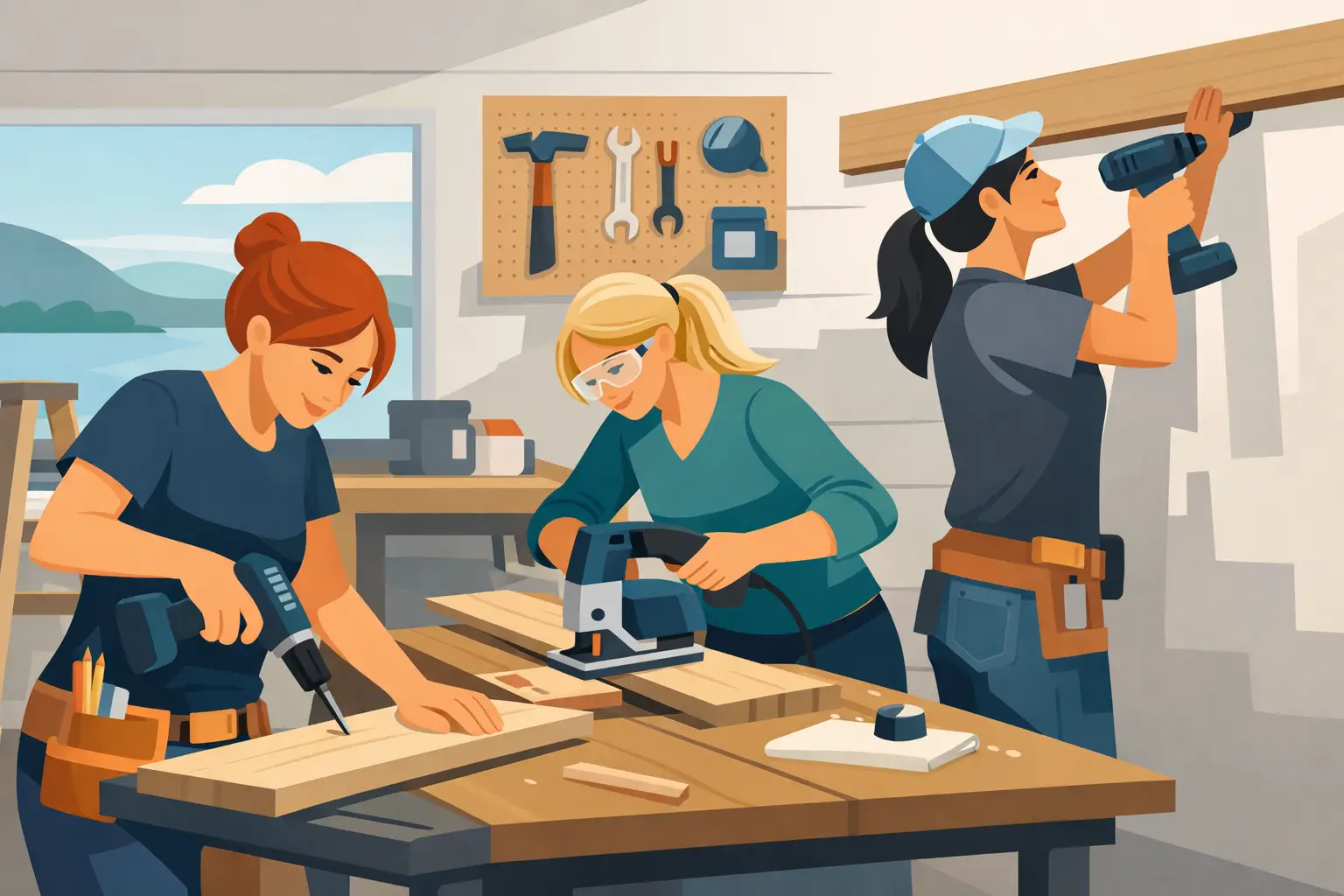
Women’s DIY Training Northern Ireland
Women’s DIY training Northern Ireland builds confidence, practical skills and independence through hands-on workshops in a supportive setting.

There is a big difference between watching someone use a drill online and feeling steady enough to use one yourself. That gap – between seeing and doing – is exactly why women’s DIY training Northern Ireland matters. For so many women, the real barrier has never been ability. It has been access, confidence and the chance to learn in a space that feels welcoming rather than intimidating.
DIY has often been treated as something you just pick up, usually from a partner, a parent or by trial and error. That leaves a lot of women shut out before they even begin. If you were never shown how to put up a shelf, isolate a fitting, use a saw safely or tackle basic home maintenance, it is easy to assume those skills are not for you. They are. You simply need the right starting point.
Why women’s DIY training in Northern Ireland matters
Practical skills change more than the room you are working on. They change how you feel in your own home. Knowing how to make simple repairs, improve a space or build something with your own hands brings a sense of control that is hard to overstate. A loose handle, damaged tile or awkward empty corner stops being a problem you have to live with and becomes something you can sort.
For many women, there is also a deeper layer to this. Traditional trade and workshop environments can feel overly technical, rushed or dismissive, especially for beginners. That does not encourage learning. It encourages silence, second-guessing and the feeling that everyone else already knows more than you do.
A women-focused training space shifts that completely. The pace is different. Questions are welcomed. Mistakes are part of learning, not something to feel embarrassed about. You are not expected to arrive confident. You build confidence by doing the work.
That matters for teenagers learning practical independence, for women running households, for renters wanting to understand the basics, for homeowners tired of waiting on small jobs, and for anyone who simply wants to make things and enjoy the process.
What good DIY training should actually teach
Not every class that mentions DIY delivers useful, lasting skills. The best training is hands-on, clear and grounded in real life. It should leave you better equipped to handle the kinds of jobs that crop up in ordinary homes, while also helping you feel safer and more capable with tools.
A strong workshop usually starts with core tool confidence. That means learning what different tools do, how to use them safely and when one option is better than another. A drill, for example, sounds simple until you are choosing bits, checking wall types and trying to avoid making a mess of the job. Once somebody breaks that down in plain English, it becomes far less daunting.
From there, practical classes often branch into skills that genuinely save time and money. Basic electrics can help you understand fittings and fixtures. Tiling and wood panelling can transform a room. Carpentry sessions can teach measuring, cutting, joining and finishing. Car maintenance classes can help you feel less dependent and more prepared.
Project-led learning is especially valuable because it gives you a finished result as well as a skill set. Building a stool, planter, lamp or side table teaches accuracy, patience and problem-solving, but it also gives you proof that you can make something solid and useful from scratch. That proof matters.
Who women’s DIY training is for
One of the biggest myths around DIY classes is that you need to be naturally practical before you book. You do not. In fact, the women who benefit most are often complete beginners.
If you have ever said, “I’m useless at this sort of thing,” there is a good chance you were never properly taught. That is not the same as being incapable. A supportive course can turn uncertainty into competence surprisingly quickly because it replaces guesswork with guided practice.
That said, beginner-friendly does not mean basic in a limiting way. Women’s DIY training can also suit hobby learners who want to broaden their skills, creative women who enjoy making things with a practical edge, and anyone who wants to move beyond decorative projects into real home improvement. There is room for the woman who wants to hang shelves properly, the woman planning to revamp a spare room, and the woman who simply wants to stop feeling nervous around power tools.
It also works brilliantly for groups. Schools, youth organisations, charities, community groups and workplace teams often find that practical workshops bring people together in a more grounded, equal way than many traditional activities. Everyone starts somewhere. Everyone leaves having made or learned something tangible.
What makes a training environment feel safe and useful
The right environment can be the difference between enjoying a class and never wanting to try again. A good workshop should feel encouraging, but not patronising. You want to be supported, not spoken down to.
That means clear instruction, plenty of demonstration and time to practise properly. It means being able to ask what feels like a basic question without embarrassment. It means learning from someone who understands that confidence is built step by step.
It also means recognising that not everyone wants the same thing from a course. Some women want quick, practical household skills they can use immediately. Others want a creative outlet. Others are looking for a confidence boost after a life change such as moving into their own place, managing a home alone or simply deciding they are tired of relying on others for every small repair. Good training makes space for all of that.
This is where a female-focused workshop model has real value. It is not about excluding anyone for the sake of it. It is about creating a learning atmosphere where women and girls can develop practical skills without the noise, pressure or posturing that too often comes with tool-based spaces.
The real outcomes go beyond DIY
The obvious result of a class is that you learn how to do something new. The less obvious result is that it changes your relationship with practical problems.
Once you have safely used tools, measured materials, corrected mistakes and finished a project, you start approaching other tasks differently. You become more willing to try. You panic less when something needs fixed. You ask better questions when you do need professional help because you understand the basics.
There is a financial side to this too, although it depends on the job. Not every repair should become a DIY task, and some work is always best left to qualified tradespeople. But many small jobs that feel expensive or disruptive become manageable once you know what you are doing. The confidence to handle straightforward tasks yourself can make home maintenance feel less overwhelming.
There is also pride in it. Not performative pride, just the quiet kind that comes from standing back and thinking, I made that. I fixed that. I know how this works now.
For a business like Building It Better NI, that is the heart of the work. The workshop might be about drills, tiling, wood panelling or a handmade lamp, but the bigger result is confidence that carries into everyday life.
Choosing the right workshop for you
If you are thinking about booking a class, start with your real goal rather than the skill that sounds most impressive. If what you need is confidence with basic home jobs, a tools or trade-basics session is probably more useful than jumping straight into a specialist project. If motivation matters more than maintenance, a creative build class may be the better first step because it gives you an early win.
It is also worth being honest about how you learn. Some women thrive in a structured class with clear stages. Others relax more when the learning is tied to making something practical. Neither approach is better. It depends on what helps you keep going when a task feels unfamiliar.
Location and delivery style matter as well. Across Northern Ireland, mobile workshops and community-based sessions can make training far more accessible, especially for women who may not want or be able to travel far for every class. That wider reach matters because practical skills should not be limited to those who happen to live near a traditional training centre.
The best first course is the one you will actually attend. Start there, learn one solid skill, and let the rest build.
You do not need to become an expert overnight to benefit from DIY training. You only need to begin. One class can be enough to turn tools from something unfamiliar into something useful, and that small shift can open up far more than a single project at home.