
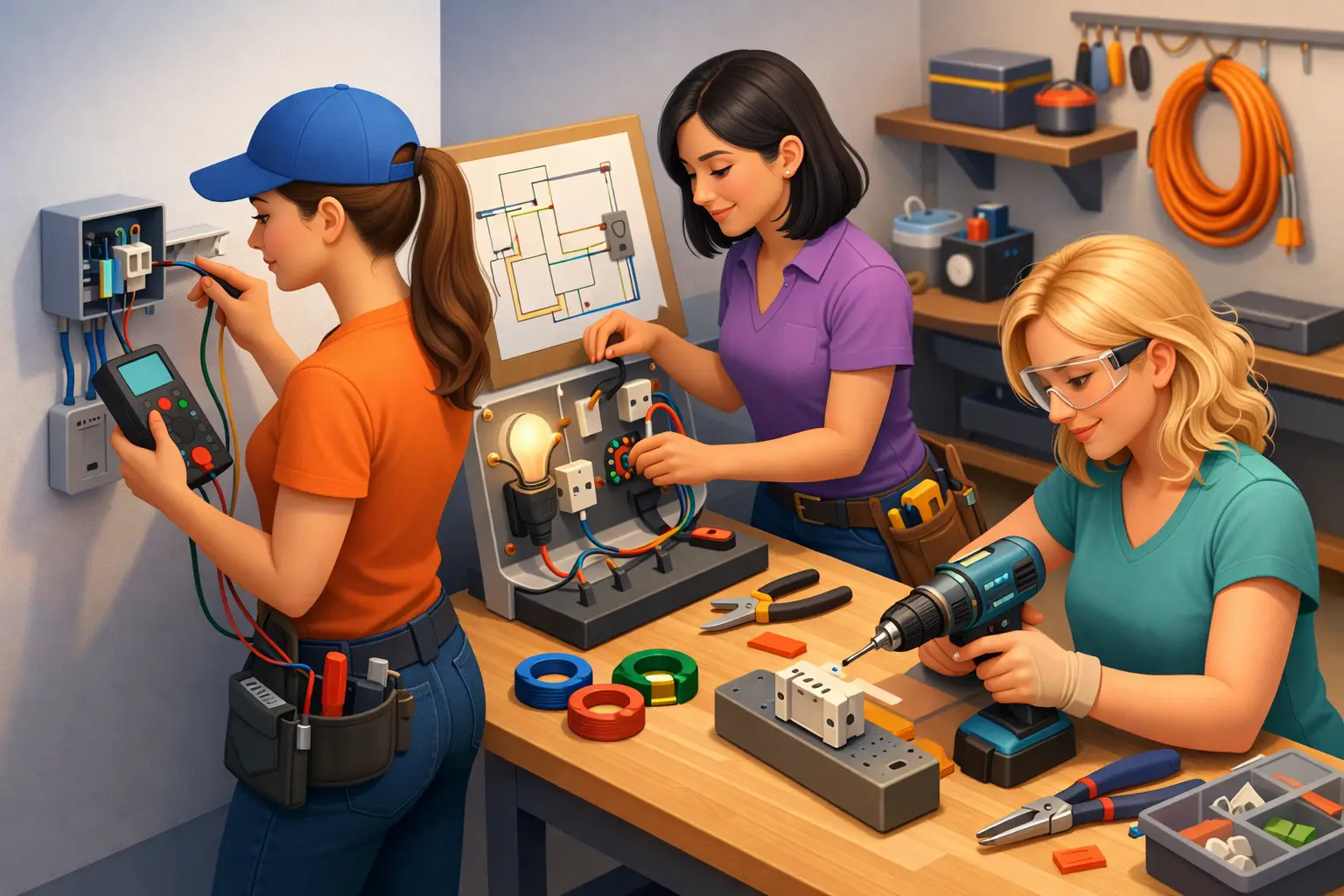
You do not need to become an electrician to stop feeling stuck when a light fitting needs changed or a switch suddenly stops working. For many women, the biggest barrier is not ability – it is being made to feel that electrics are too technical, too risky, or best left unexplored. A basic electrics course for beginners changes that. It gives you a safe, supportive starting point where you can learn what is happening behind the faceplate, what you can do yourself, and where the legal and safety boundaries sit.
That matters more than people think. When you understand the basics, you are not just learning a household skill. You are building confidence, asking better questions, making safer decisions, and feeling more in control of your own home.
What a basic electrics course for beginners should actually teach
A good beginner course should not throw jargon at you and hope for the best. It should start with the fundamentals in plain English, then let you practise with guidance. The goal is not to turn you into a professional tradesperson in a day. The goal is to help you understand core principles well enough to work safely, recognise common components, and carry out suitable small tasks with confidence.
That usually starts with understanding the difference between jobs you can learn as a homeowner or DIY learner and jobs that need a qualified electrician. This distinction is essential. Confidence is powerful, but it needs to be matched with good judgement.
From there, the teaching should cover the parts of a basic domestic electrical setup that people actually come across in everyday life. That might include switches, sockets, plugs, light fittings, circuit protection, isolation, cable colours, and safe use of tools and testers. If a course misses safety or legal context, it is not giving beginners what they really need.
Why beginners often put electrics off for years
Plenty of capable women can tile a splashback, build furniture, paint a room beautifully, or use power tools with no issue at all – but still freeze at the sight of a consumer unit or wiring diagram. That hesitation is understandable. Electricity has real risks, and many people have only ever heard one message about it: do not touch.
The problem is that fear without education does not make anyone safer. It just leaves people dependent, unsure, and more likely to ignore warning signs because they do not know what they are looking at.
A hands-on beginner course replaces vague worry with practical understanding. You learn what safe isolation means. You learn why testing matters. You learn how to identify simple components and common faults. You also learn when a job moves beyond the beginner level, which is just as important as learning what you can do.
That balance is where real confidence comes from. Not false bravado. Not guessing. Just knowing your limits and your next steps.
What you might learn in a beginner electrics workshop
The best workshops are practical from the start. Rather than hours of theory, you are shown the basics and then supported as you apply them. For many learners, that is the difference between information that sounds clever and a skill that actually stays with you.
In a basic electrics course for beginners, you may learn how to wire a plug correctly, understand fuse ratings, and identify the purpose of live, neutral, and earth conductors. You may practise fitting or changing certain types of light fittings in a controlled environment, or learn how switches and simple lighting circuits work.
You might also cover how to isolate a circuit safely, how to use basic electrical tools, and how to spot damage, wear, or poor workmanship. Some courses include fault-finding at a very introductory level, which can be especially useful if you want to understand why something has stopped working before calling in help.
Not every course will cover the same ground, and that is fine. Some focus more on home maintenance. Others lean into understanding systems and components. The key question is whether the course gives you practical skills you can picture using in real life.
Safety comes first – and that is a good thing
People sometimes hear the word safety and assume it means restriction. In reality, safety knowledge is what makes learning possible. Once you understand the risks properly, electrics stop feeling mysterious.
A worthwhile course should explain safe isolation clearly and repeatedly. It should teach respect for electricity without turning every lesson into a warning. That tone matters. If learners are made to feel frightened, they hold back. If they are taught with care and clarity, they engage properly and ask questions.
This is also where a female-focused learning space can make a real difference. Many women have had the experience of being talked over, rushed, or made to feel silly for not already knowing the answer. In the right setting, there is room to learn at your own pace, handle tools yourself, and build skill through doing rather than watching someone else take over.
How to choose the right basic electrics course for beginners
Not every beginner course is truly beginner-friendly. Some say they are for newcomers but move too quickly, assume prior knowledge, or focus more on showing expertise than teaching well.
Look for a course that explains exactly what is covered and what is not. Clear learning outcomes are a good sign. So is a practical format where you get hands-on experience rather than just a demonstration from the front of the room.
It also helps to check how the course approaches confidence-building. That may sound softer than technical content, but it matters. If the environment is welcoming, respectful, and designed for questions, most people learn faster and remember more. Building It Better NI, for example, centres that kind of supportive, hands-on learning for women who want practical skills without the usual intimidation.
You should also consider what you want from the session. If your aim is simple home confidence, a short workshop may be enough. If you want broader DIY ability, it may make sense to combine electrics training with other practical classes over time. Skills tend to reinforce each other. Once you are comfortable using tools, measuring accurately, and thinking through a job step by step, electrics often feels less daunting.
What a course will not do – and why that is fine
A beginner electrics course is not a shortcut to professional qualification, and it should never pretend to be. There are legal, technical, and safety reasons why some electrical work must be done by qualified people.
That does not make beginner learning less valuable. It makes it more realistic.
The real benefit is knowing how your home works at a basic level, being able to carry out suitable small tasks safely, and understanding when to bring in an electrician. That knowledge saves time, reduces stress, and helps you avoid being completely at the mercy of jargon or guesswork.
There is also a quieter benefit that people often do not mention until afterwards. Once you have successfully completed one practical task involving electrics, other jobs around the home start to feel more possible too. You become less likely to put things off and more likely to trust yourself to learn.
The confidence effect reaches beyond the job itself
A lot of women book a practical course because they want to sort one specific problem. They want to understand lighting, replace a fitting, or stop feeling clueless around wiring. What often surprises them is that the shift is bigger than the task.
Learning a practical skill changes how you carry yourself. It changes the questions you ask. It changes whether you wait for someone else or have a go yourself within safe limits. That matters at home, but it can also spill into work, study, creativity, and everyday decision-making.
There is something powerful about realising you can learn skills that once felt closed off to you. Not because someone handed you confidence in a speech, but because you used your own hands, made sense of the process, and saw the result for yourself.
If you have been thinking about taking a basic electrics course for beginners, you do not need to wait until you feel less nervous or more technical. The course is there for the nervous beginner. Start there, ask the basic questions, and let the confidence come after the first practical step.
I would be interested. I live in Derry
Hi Teresa you can look at https://buildingitbetterni.com/events/?ameliaEventId=63&ameliaEventPopup=63 is isnt an electric course its a DIY course but have been very popular it is fully booked but if you want I could squeeze you in just email roger@buildingitbetterni.com. As for the electics course take a look at buildingitbetterni.com/events as this page lists all the events and the one that does the electrics course is in belfast the 18th of july and yes I know its a bit far to go for a two day course or Coleraine Electrics Course 4th & 5th July with one space left.