
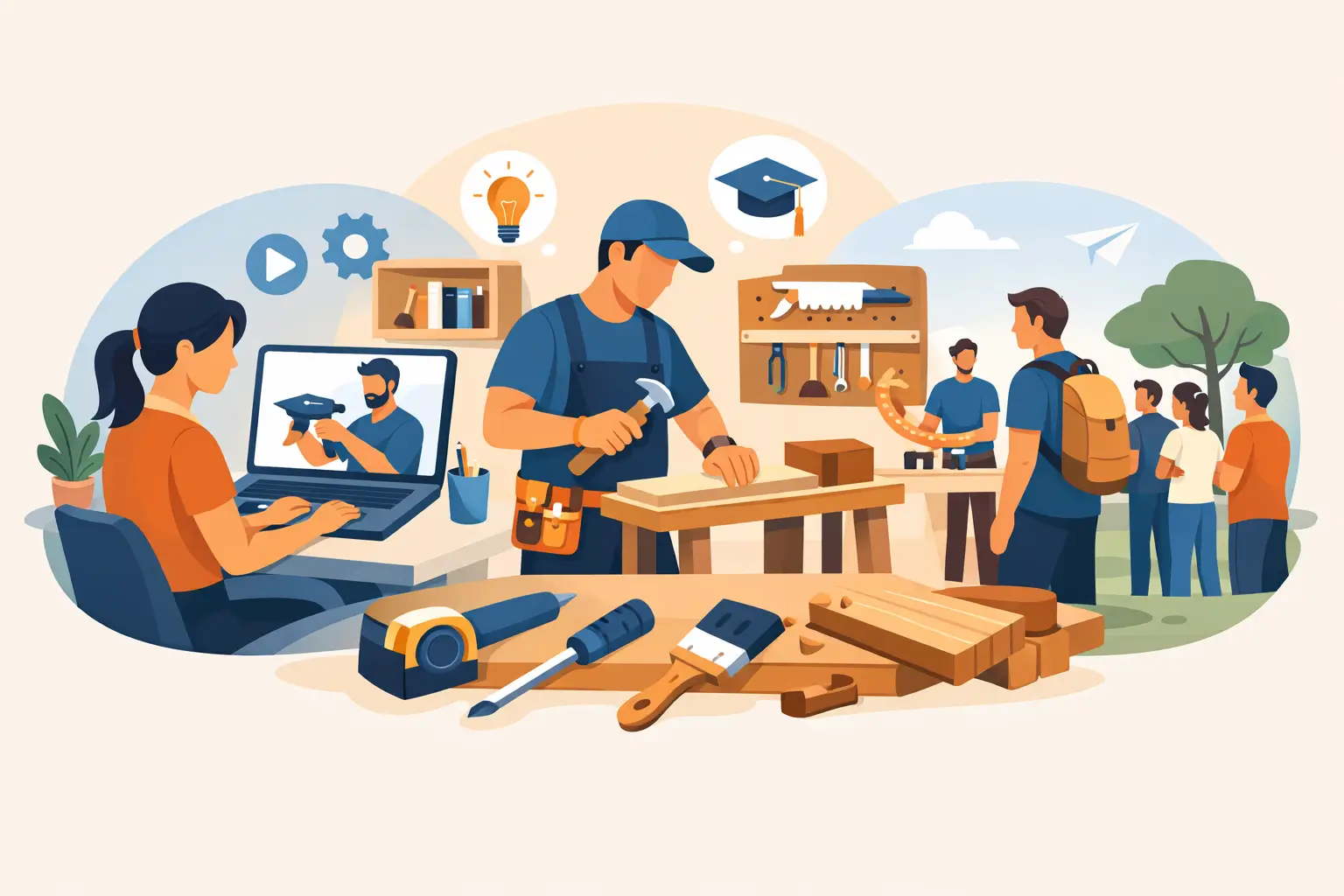
The first time you use a drill, tile a wall, or change a car wheel, the real question is rarely whether you are capable. It is usually where to learn DIY skills in a way that feels clear, safe and genuinely welcoming. For many women, that matters just as much as the skill itself.
DIY has long been treated as something you either grow up around or somehow pick up as you go. That leaves plenty of people feeling as though they have missed the memo. They have not. Practical skills can be learned at any age, and often far more quickly than expected when the teaching is hands-on, supportive and built for real life.
Where to learn DIY skills depends on how you learn best
There is no single right route into DIY. The best place to start depends on what you want to do, how confident you feel with tools, and whether you learn better by watching, reading or getting stuck in straight away.
If your goal is basic home confidence, such as hanging shelves, using a drill properly, sealing a bath or understanding simple electrics, a practical class is usually the strongest option. You get guidance in the moment, you can ask what feels like a silly question without judgement, and you leave having actually done the thing rather than just watched someone else do it.
If you already have a little experience and want to tackle a specific project at home, online videos and step-by-step guides can be useful. They are flexible, low-cost and easy to revisit. The trade-off is that they cannot correct your grip, check your measurements or tell you when you are about to make an expensive mistake. That does not make them useless. It just means they work best as support, not always as the whole answer.
Then there is the informal route – learning from friends, family or neighbours. That can be brilliant if the person teaching you is patient and good at explaining. It can also be frustrating if they rush, take over, or assume you know more than you do. Plenty of women have had the experience of asking to learn and ending up simply watching somebody else finish the job.
The best places to learn DIY skills
A hands-on workshop is often the fastest way to build both ability and confidence. That is especially true for beginners. You are shown how to use tools safely, why certain steps matter, and how to avoid the common problems that put people off. More importantly, you get to practise in a space where learning is expected.
That atmosphere matters more than people sometimes realise. A good workshop does not make you feel behind. It does not talk over your head or turn practical learning into a test of how much jargon you know. It helps you understand what you are doing and why, then gives you the chance to try it yourself.
For women and girls, the setting can make a huge difference. Traditional trade environments are not always designed to feel accessible. They can be overly technical, overly competitive, or simply not welcoming. A female-focused learning space can remove that pressure. It allows people to ask questions freely, make mistakes, and build confidence without feeling judged for being new to it.
That is one reason structured DIY training has become such a strong option. Businesses such as Building It Better NI are built around the idea that practical skills are not just about home maintenance. They are about independence, resilience and knowing you can handle more than you thought.
Community learning can be a strong starting point
If signing up to a workshop feels like a big step, community-based learning can be a good entry point. Local groups, schools, youth programmes and women’s organisations sometimes run DIY taster sessions or creative making classes. These settings tend to be relaxed and social, which can help if nerves are the main barrier.
This route is especially useful for younger learners or anyone rebuilding confidence after a long gap. A short session on using hand tools, making a simple item or understanding fixings can shift your mindset surprisingly quickly. Once you stop seeing tools as unfamiliar objects and start seeing them as things you can use, everything changes.
There is also value in learning alongside others who are starting from the same place. It reminds you that needing instruction is normal. No one is born knowing how to cut timber accurately or wire a plug. Skills come from practice, not from some secret practical gene.
Online learning has its place, but it has limits
There is plenty of free DIY content online, and some of it is genuinely helpful. If you want to compare methods, understand terminology or refresh your memory before a project, digital resources can do a good job. They are convenient and often ideal for smaller jobs.
But online learning has weaknesses, especially for complete beginners. Camera angles can hide important details. Safety steps may be skipped. Difficulty is often underestimated by people who already know what they are doing. A five-minute clip can make a task look simple when the reality involves more preparation, more tools and more patience.
That does not mean you should avoid learning online. It simply means being honest about what you need. If you are trying something that involves power tools, electrics, load-bearing fittings or anything that could cause injury or damage, in-person guidance is usually the wiser starting point.
What to look for when choosing where to learn DIY skills
The best DIY training does more than deliver information. It builds confidence through action. When you are deciding where to learn DIY skills, look at whether the course is genuinely practical, not just demonstration-based. Watching is useful, but doing is what makes the learning stick.
It is also worth checking whether the course is aimed at beginners. Some classes say all levels are welcome, but still assume a fair amount of prior knowledge. A strong beginner session explains basics clearly, introduces tools properly and leaves space for questions.
Think about the outcome as well. Do you want to learn a broad foundation, such as tool handling and home repair basics, or do you want a project-led class where you build something specific? Both have value. The first gives you transferable skills. The second can be brilliant for motivation because you leave with visible proof of what you can do.
The teaching style matters too. Supportive instruction is not a soft extra. It affects how much you are willing to attempt, how well you recover from mistakes and whether you come back to learn more. People grow faster in environments where they feel capable, not scrutinised.
Start with the skill that gives you the most immediate win
One of the biggest mistakes beginners make is thinking they need to learn everything at once. You do not. Start with the skill that will change your day-to-day life quickest.
For some people, that is learning to use a drill and wall fixings properly so they can hang shelves, mirrors and curtain poles without waiting for help. For others, it is understanding simple repairs around the house, basic tiling, wood panelling or how to use common hand and power tools safely. If you drive, basic car maintenance can be a powerful place to begin because it replaces uncertainty with calm when something goes wrong.
Early wins matter. They make DIY feel less like a mysterious category and more like a set of learnable actions. Once that shift happens, people often go further than they expected. A woman who signs up to learn one household task may soon be building furniture, improving rooms, or taking on projects she once assumed were for somebody else.
DIY skills are not just practical – they change how you feel at home
Learning to fix, build and maintain things yourself does save money over time, although that is only part of the story. The deeper value is confidence. When something breaks, you are less likely to panic. When you want to change a space, you are more likely to imagine possibilities rather than obstacles.
That sense of self-reliance has a ripple effect. It can shape how you approach your home, your finances and your own ability to learn new things. It also creates something worth sharing. When women learn practical skills, they often pass them on to daughters, friends, colleagues and community groups. Confidence spreads that way.
If you have been waiting until you felt ready, consider this your permission to begin before that feeling arrives. The right place to learn is the one that lets you ask, try, practise and grow without being made to feel small. Start there, and let your hands teach your confidence what it is capable of.